Fighting to have the last word does not preserve what truly matters; look at what this victory actually cost you.
Five of Swords at a glance
- Upright keywords
- Conflict and hostility · Costly victory · Choosing your battles
- Reversed keywords
- Seeking reconciliation · Regretting hurtful words · Lingering conflict
- Time to act?
- Upright: hold off for now; reversed: it depends on conditions
- Upright advice
- Before arguing back, name the concrete problem you want this conversation to solve.
What does the Five of Swords mean upright?
The Five of Swords upright represents conflict, resentment, and tension, while serving as a sober reminder of the true price of winning. You might have forced the other person to concede, but lost mutual trust and respect in the process, fracturing the relationship.
The argument is over, yet as you stand there, your chest feels no lighter. The figure gathering swords stays on the field while others walk away defeated; victory can feel an awful lot like loss.
Fixating solely on coming out on top pushes people away, making the fallout harder to repair. The number five often brings friction and disappointment; this battle has produced a clear winner and loser, leaving distance between them.
When every differing perspective is treated as a threat, conversation devolves into attack and defense. Acknowledging that a fight is not worth pursuing is an exercise in knowing your limits and choosing battles that actually matter.
What does the Five of Swords mean reversed?
The Five of Swords reversed can signal a desire to lay down hostility, feeling remorse over what was said and wanting to find common ground. Someone seeking peace might retract sarcastic remarks and ask what they can do to make amends.
You may not seek instant intimacy, but hope that the next conversation does not begin with an argument. Repair begins by admitting the phrase that cut the other person, without demanding an immediate return to how things were.
Conflict can also remain unresolved or escalate further, dragging you back into disputes whenever you try to move forward. In an unresolved dispute, you try discussing practical plans only for the other person to weaponize a past grievance.
Silence does not necessarily mean peace has arrived; your shoulders might tense up just anticipating the next talk. When dialogue fails, stepping away from the argument or relationship is a valid and protective choice.
What does the Five of Swords mean in love?
Single or getting to know someone
Upright: Conversation can turn into a contest, trying to prove your taste is superior even when picking a movie. You pull up reviews to argue your case, typing furiously, while the genuine desire to connect goes unspoken. Try saying: "It is completely fine that we like different things," letting differences exist without ranking them.
Reversed: They may feel regret over a previous argument, wanting to understand your perspective better. Notice how they handle your differing opinions: when you dislike a novel, do they listen to your reasons or rush to correct you? A willingness to understand is worth far more than a hasty "don't be mad."
In a relationship
Upright: Struggling over who is right leaves both partners feeling isolated even after winning an argument. Disputing whose turn it is to clean the bathroom, you dredge up past mistakes, leaving your mouth dry while the brush sits untouched.
Sit down and write out a fair chore split on paper, putting practical needs ahead of winning.
Reversed: When conversations consistently hit a wall, continuing to fight rarely reduces harm. Your agreed-upon downtime is interrupted by knockings and accusations, requiring you to justify taking a breath. Say: "I am done talking for today, I need to rest," exiting this round of conflict to reflect on your boundaries.
After a breakup or hoping to reconcile
Upright: You may want to prove that leaving was the winning move, even wanting to include a biting note when returning their belongings. Taping up the package, you revise those sharp sentences in your head. Hold back that stinging note; return their items cleanly without delivering unfinished bitterness into their hands.
Reversed: Mending fences often begins with owning your own regrets. Before reaching out, practice replacing "you ruined everything" with an acknowledgment of the ways you caused hurt, naming what you are willing to make right. If hoping to reconcile, can you name one habit you will change during the next conflict?
What does the Five of Swords mean regarding someone's feelings toward me?
Cards cannot confirm another person’s true feelings; this section helps you explore possibilities rather than answer on their behalf.
Upright: They may feel defensive and misunderstood, speaking with an urge to argue and prove who is right.
Reversed: They may wish to put down their resentment and feel remorse over past harshness, showing readiness to listen and rebuild understanding.
What does the Five of Swords mean for work and money?
Job hunting and interviews
Upright: Salary discussions can deteriorate into an adversarial contest where you focus solely on outmaneuvering the recruiter. You rehearse aggressive counteroffers until you lose sight of what compensation you actually need. Prepare a list of negotiable terms, keeping discussions centered on job needs rather than pride.
Reversed: When reconsidering an employer after a tough exchange, see if they show a genuine willingness to negotiate. When you raise questions about a trial project scope, do they adjust expectations reasonably, or simply demand compliance? Let their handling of differences guide your decision.
In your current job
Upright: Hostile dynamics may emerge where louder voices intimidate others into silence. Delivering your progress report, someone cuts you off by slamming the table, leaving your pen frozen and words stuck. When facing intimidation or bullying, document incidents factually and report them to HR rather than bearing it alone.
Reversed: Workplace hostility can degenerate into petty sabotage, making collaboration nearly impossible. During shift handoffs, vital files are withheld, leaving you staring at blank spreadsheets. Write: "I need this document to finalize the handover," keeping requests tracked on official channels without retaliating.
Money
Upright: Financial conflict often arises when someone takes more than their fair share. Splitting profits from a joint event, a collaborator claims sole credit for group labor while you review the ledger, wanting to object yet fearing conflict.
Do not agree to the split yet; specify which shares need renegotiation instead of swallowing resentment.
Reversed: Financial disagreements may soften as both sides show willingness to renegotiate burdens. Someone occupying extra space in a shared storage unit agrees to discuss splitting the rent fairly. Document agreed-upon terms in writing, providing a tangible foundation for reconciliation.
What does the Five of Swords mean for friends, family and coworkers?
Upright: To prove yourself right in front of relatives, you might weaponize a secret a friend shared in confidence. Once spoken, your ears burn, knowing you crossed a boundary you never intended to touch. What valuable bond are you sacrificing just to win this argument? Next time you are provoked, keep their confidence safe.
Reversed: You might want to dissolve hostility with a friend but hesitate on how to begin. Setting up gear for club practice, you remember your sarcastic comment from last week. Say: "What I said last time was hurtful, and I am truly sorry," taking full ownership without dictating when they must accept it.
What does the Five of Swords mean for personal growth?
Upright: Losing a round can make you feel as though your dignity was stripped away. The chess match ends, and you stare at the final move wishing you could undo it, your fingers still clutching the piece. Once your hand relaxes, ask: what limit did this show me?
Recognizing limits points you where to put effort next, without rejecting your worth.
Reversed: Regret over harsh words can make you want to redirect energy into something constructive. Sitting at the piano, your mind replays the argument while the sheet music sits unplayed. Play through just one short measure, letting today hold something free from victory and defeat; taking responsibility does not require constant self-punishment.
What can you do when the Five of Swords is your advice card?
Upright: Before arguing back, name the concrete problem you want this conversation to solve. You may want vindication, but the more you push, the farther you drift from resolution. Weigh whether being right is worth damaging the relationship; when a battle is not worth fighting, stop adding hurtful words.
Reversed: Offer practical amends for a mistake you are ready to repair, rather than merely asking someone to forget it. If you broke shared equipment, handle the repairs; if you took credit that was not yours, restore their name.
If they decline to talk, respect that boundary; repair includes not forcing another round of contact.
Does the Five of Swords say yes to what you asked?
Upright: Not a good time to force a resolution by humiliating or overpowering the other side. Especially if tempted to expose someone's shortcomings publicly to prove your point, weigh the lasting cost of winning.
Reversed: It depends on whether both sides can negotiate. If there is mutual willingness to make concrete amends, try repairing things; if conversation instantly descends into personal attacks, stepping away is the wiser choice.
Common questions about the Five of Swords
What kind of person does the Five of Swords represent?
Someone who relishes having the upper hand, acting with smugness or cunning to win at all costs with little regard for who gets hurt. Clues include mocking mistakes and using intimidation to quiet dissent. Reversed, it describes someone trying to drop hostility and expressing regret over past cruelty.
How should I interpret the Five of Swords reversed in a future position?
Consider both potential trajectories of the reversed card: a willingness to reconcile, or lingering conflict that refuses to heal. Focus on whether both parties are willing to adjust demands in practice, which indicates whether space for genuine repair truly exists.
Does the Five of Swords imply that conceding defeat is shameful?
No; conceding can show you which battles are simply not worth fighting. Upright, it warns against sacrificing trust just to avoid admitting defeat; reversed, it permits you to channel energy into making amends, or walking away when negotiation fails.
Treating a loss as experience frees you from needing another fight to prove your worth.
A note from stilltarot
You rehearsed that sharp final retort in your mind, yet when the moment comes to speak it, you remember when the two of you spoke with care. The urge to demand fairness and the hesitation to cause further pain both deserve to be heard.
Loosen your jaw today; you do not have to give that harshest sentence a way out.
How it differs from similar and opposite cards
- Similar: Seven of Swords: The Seven of Swords connects to stealth, deception, and avoidance, while the Five of Swords centers on open confrontation, hostile arguments, and the isolating cost of winning at others' expense.
- Opposite: Temperance: Temperance values patience, harmony, and balanced cooperation, while the Five of Swords focuses on conflict, ego-driven victory, and what is sacrificed when someone insists on winning.
What do the imagery and Waite’s original text of the Five of Swords mean?
In the 1909 Rider-Waite-Smith deck, a figure looks scornfully over his shoulder at two dejected figures walking away, carrying two swords upon his left shoulder with a third pointed toward the ground. Two discarded swords lie at his feet under a gusty, cloud-torn sky.
In his 1910 book The Pictorial Key to the Tarot, A. E. Waite refers to the victor as master of the field, yet assigns divinatory meanings of dishonor, loss, and degradation, refusing to portray this victory as honorable.
- Figure collecting swords: One person gathers the fallen swords as others walk away, depicting victory achieved through others' loss.
- Departing figures: The two figures walking away with slumped shoulders carry sorrow, humiliation, and defeat.
- Swords on the ground: The discarded swords show that while the battle has ended, its damaging aftermath remains.
- Turbulent storm clouds: The agitated, wind-swept sky suggests that even after fighting stops, lasting peace is far from settled.
Related cards
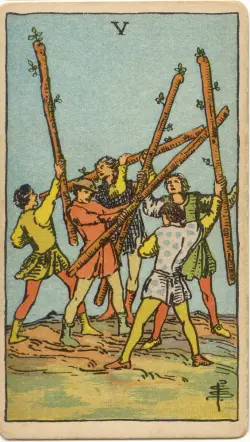
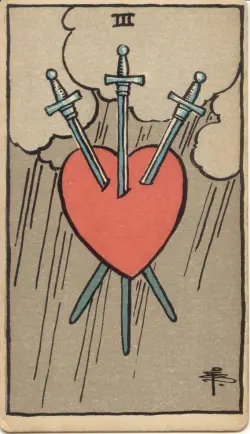
Something on your mind? Let the cards help you look at it.
Ask a question with three cardsSources
- A. E. Waite | The Pictorial Key to the Tarot, Part III §2: Five of Swords: Original description of the card illustration and upright and reversed divinatory meanings.
- Five of Swords | Biddy Tarot: Consulted on conflict, the cost of winning, reversed unresolved disputes, and picking battles wisely.
- Five of Swords | Labyrinthos: Consulted on hostility in relationships and work, financial disputes, defensiveness, and reversed remorse and compromise.
- Five of Swords | Learning the Tarot: Consulted on the isolation of self-interest, intimidation, hollow victories, and card comparisons.
- Five of Swords | Aeclectic Tarot: Consulted on the price of broken connections, recognizing limits, and ongoing friction.
Meaning updated: 2026-11-04 Card meanings are edited with AI assistance.
Tarot meanings are for self-reflection and reference only. They cannot predict the future, prove what someone else thinks, or guarantee an outcome. For decisions about health, law, money, pregnancy or personal safety, please talk to a qualified professional.