Find support in well-trodden paths and shared beliefs, while noticing whether those rules still leave room for your authentic self.
The Hierophant at a glance
- Upright keywords
- Tradition and beliefs · Learning from mentors · Group belonging
- Reversed keywords
- Questioning old rules · Independent judgment · Rigid dogma
- Time to act?
- Upright: a good time to act; reversed: it depends on conditions
- Upright advice
- Find a mentor you trust and ask them to walk you through a foundational skill.
What does The Hierophant mean upright?
The Hierophant upright represents finding a reliable direction through traditional beliefs and systematic teaching. When facing unfamiliar territory, having someone spell out the steps gives you a path to follow. Rather than inventing a new system, this state leans toward using proven methods and seeking guidance from experienced mentors.
The symbol of the two kneeling acolytes connects to the transmission of knowledge, reminding you that this path is walked alongside predecessors rather than in isolation.
Shared beliefs and rituals give a group an identity where members recognize one another. Walking into a familiar gathering, knowing when to stand and when to speak the same words in unison, you find yourself belonging. Aligning with shared norms and cooperating with the group can sometimes suit the current situation far better than standing out.
From holiday traditions to steady spiritual practice, repeated actions carry the values embraced by the community.
What does The Hierophant mean reversed?
The Hierophant reversed represents beginning to question inherited rules, seeking a way of living truer to yourself. Hearing "this is how everyone does it," you want to ask why, your pen hesitating before the agreement line.
If you can name which rule conflicts with your values, use that as a starting point to explore alternatives. Leaving conventional answers often brings friction with family or authority; before choosing, consider what consequences you are willing to bear.
Another state worth discerning is authority treating rules as unquestionable dogma. Rules open to reasoned discussion invite people to ask why; when discussion shrinks to "just do as you are told," personal discernment is shut out.
Groups sometimes demand compliance under the banner of morality or by restricting information. If you find yourself using similar phrases to silence others' questions, pause and let different perspectives be heard.
What does The Hierophant mean in love?
Single or getting to know someone
Upright: You may care deeply about aligned values, hoping to meet someone for steady, mutually supported companionship approved by those around you. When family habits come up in conversation, say: "I place great value on keeping promises," letting them know your standards.
This brings you closer to real connection than checking off an ideal partner checklist.
Reversed: Friends insist that someone with such great credentials deserves a yes, yet looking at the invite, you feel no desire to go. Conventional courtship models do not always match the relationship you want. Set aside what others consider suitable for now and delay answering, giving yourself time to discern whether you truly want to draw closer.
In a relationship
Upright: Taking commitment seriously together may be what matters most to both of you right now. When marriage is discussed, listen to how they describe family traditions and view the responsibilities of shared living. Rather than settling for a simple answer about getting married, explore what everyday realities your shared commitment entails.
Reversed: One person views living together as essential while the other wants to keep separate spaces, making even furniture shopping feel suffocating. When visions of the future diverge, daily interactions feel cramped. Say: "I want to talk about living separately for now," making the divergence concrete rather than letting societal relationship scripts replace your conversation.
After a breakup or hoping to reconcile
Upright: Memories of celebrating holidays together and meeting family resurface, giving you pause. After parting, commitments once shared may linger on your mind. Before attempting reconciliation, clarify: What shared relationship responsibilities did we leave unaddressed? Keep that answer as a starting point for future talks.
Reversed: A casual remark from others—"You two should just get back together"—lingers in your mind on the walk home. Advice given by outsiders does not always fit the reasons you parted. Decline answering to others' expectations today, leaving room for your own life arrangements.
When drawing The Hierophant, what are their thoughts and feelings toward me?
Cards cannot confirm another person’s true feelings; this section helps you explore possibilities rather than answer on their behalf.
Upright: They may respect and admire you, value shared beliefs, and look forward to a steady, committed relationship.
Reversed: They might feel confused by conventional expectations around dating, wanting closeness while preserving freedom, leading to hot-and-cold behavior.
What does The Hierophant mean for work and money?
Job hunting and interviews
Upright: A job posting mentions expertise you have not yet mastered. Compare course syllabi against missing fundamentals and map out your study sequence. Structured training can bridge the gap to role requirements. Connecting foundational learning to practical exercises brings order, making the application process feel far less daunting.
Reversed: When organizational structures are overly rigid, requiring multiple layers of approval for minor workflow tweaks, feeling restricted surfaces quickly. When comparing openings, ask the company what procedures exist for employees offering differing opinions; factor that into your choice rather than judging only by job title.
In your current job
Upright: Having just taken on a task with unclear handover standards, working alongside your team's established division of labor may be wiser than figuring it out alone. Ask a senior colleague: "Could you explain the completion standards?" Follow proven methods while clarifying where you feel uncertain.
Reversed: A meeting demands that everyone endorse a decision you disagree with, leaving you unable even to suggest changing a table column. Rigid processes stifle ideas. Before speaking up, consider: What workplace impacts am I willing to bear by openly opposing this? Anchor your dissent in reality while weighing the consequences.
Money
Upright: Someone urges you to join an unfamiliar investment group, yet the introductory terminology makes no sense to you. Financially, lean toward familiar, mature channels, avoiding instruments you do not understand. Hold off on joining or wiring money for what remains unclear, preserving room for discernment rather than following the crowd.
Reversed: You might want to explore unconventional income streams and feel curious about new financial options. Before paying an entry fee on a side-gig platform, run a worst-case calculation: how much invested capital is lost if zero income results?
Factor potential loss into your exploration rather than evaluating suitability on novelty alone.
What does The Hierophant mean for friends, family and coworkers?
Upright: Shared traditions and beliefs are where people draw close within a community. If friends regularly join a community initiative and you want to participate without knowing how to step in, ask yourself whether you align with its purpose.
If you do, attend a public gathering, beginning connections through shared activity.
Reversed: At a gathering, someone criticizes you for not conforming, leaving your lips pressed tight and hands clutching your glass. When a group accepts only one answer, minor disagreements create tension. Step outside for a walk, waiting until your heart slows down before deciding whether to return.
When struggling to refuse group pressure, consult someone trusted outside the group.
What does The Hierophant mean for personal growth?
Upright: Regular reading or quiet contemplation provides a way to settle your spirit. Familiar rituals or practices can offer anchor points when feeling directionless. Carve out an uninterrupted window today: arrange your chair, silence notifications, and complete your practice in the familiar way, letting your beliefs land in daily life.
Reversed: Filling out a registration form, your mind fixates only on options your family endorses. Inherited values might not all fit who you are today. Open a separate list of courses, noting one personal reason for wanting to study each; ensure your choice reflects your discernment rather than merely replicating others' expectations.
What can you do when The Hierophant is your advice card?
Upright: Find a mentor you trust and ask them to walk you through a foundational skill. Bring the specific step where you are stuck, ask them to demonstrate, and practice alongside them. If there is a learning community you resonate with, join regular sessions, combining guidance with peer exchange in the same learning journey.
Reversed: Pick one rule that leaves you feeling constrained and question the value it was meant to protect. If its method is no longer useful, propose an alternative arrangement that honors that core value. Extend flexibility when others walk a different path; the freedom to question belongs equally to everyone.
Does The Hierophant say yes to what you asked?
Upright: Favorable for following established methods, receiving mentorship, or participating in collaborations with shared standards. Entering structured training and building from fundamentals fits your current direction far better than rushing to reinvent the wheel.
Reversed: It depends on whether you seek to revise unworkable rules or demand that others obey without question. The former welcomes exploring alternative approaches; the latter suggests pausing to allow differing perspectives into the conversation.
Common questions about The Hierophant
What kind of person does The Hierophant represent?
A teacher or guide who systematically imparts knowledge and provides direction during difficult times, or a trusted figure within a spiritual community or institution. Reversed, they may be an authoritarian demanding obedience without discussion, or someone questioning institutions to forge their own path.
When drawing The Hierophant, how should I approach studying or licensing exams?
Approach preparation through formal coursework and foundational principles, following the study sequence laid out by instructors. When encountering difficult concepts, consult teachers with your work shown, as this highlights gaps far better than memorizing answers.
Reversed, check whether study materials and teaching methods fit your needs before seeking alternative approaches.
Does The Hierophant always relate to religious faith?
Not necessarily; the focus can equally be a school or any group bound by shared convictions. Upright leans toward learning through lineage and formal instruction; reversed examines inherited viewpoints to identify what conflicts with your personal values.
If your question involves faith, consider which beliefs you truly endorse and the meaning behind the rituals you practice.
A note from stilltarot
Hearing familiar teachings, you sometimes nod along and sometimes keep your questions to yourself. Along the road you have walked, certain rules supported you, while others now feel tight on who you are today. Tonight, open a book that once offered you direction, read a short passage, and allow yourself to leave a mark where you disagree.
How it differs from similar and opposite cards
- Similar: The High Priestess: The High Priestess and The Hierophant both connect to spiritual understanding; the former keeps exploration within the individual's inner world, while the latter turns belief into communal teachings.
- Opposite: The Fool: The Fool leans toward freedom from convention, moving with the present moment; The Hierophant follows established customs, referencing collective lineage.
What do the imagery and Waite’s original text of The Hierophant mean?
In the 1909 Rider-Waite-Smith edition, a figure wearing a triple crown sits between two pillars, holding a triple cross scepter in one hand and making a gesture of blessing with the other. Crossed keys lie at his feet, and two tonsured ministers kneel before him.
In The Pictorial Key to the Tarot (1910), A. E. Waite connects this figure to outer religion, public doctrine, and recognized hierarchy.
- Triple crown: The three-tiered crown representing the conscious, subconscious, and superconscious realms.
- Two kneeling figures: Two acolytes representing initiation into learning and the transmission of sacred knowledge.
- Crossed keys: Representing balance between conscious and subconscious minds, and the doorway to mysteries.
- Gesture of blessing: The raised hand of blessing connecting celestial realms with the earthly world.
Related cards
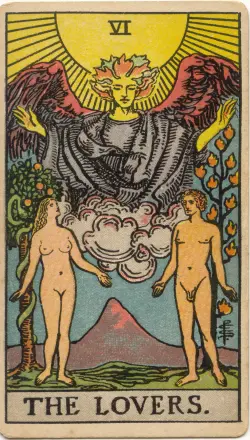
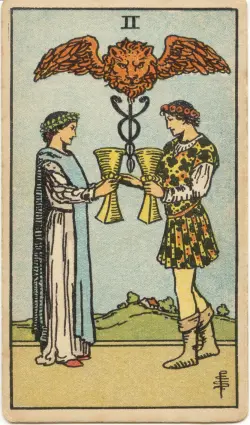
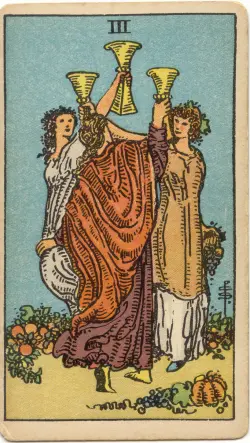
Something on your mind? Let the cards help you look at it.
Ask a question with three cardsSources
- A. E. Waite | The Pictorial Key to the Tarot, Part II §2: The Hierophant: Original description of the card's illustration.
- A. E. Waite | The Pictorial Key to the Tarot, Part III §3: The Hierophant: Original divinatory meanings for upright and reversed positions.
- The Hierophant | Biddy Tarot: Reference for formal learning, shared beliefs and rituals, and exploring personal paths when reversed.
- The Hierophant | Labyrinthos: Reference for commitment and values in love, workplace institutional pressure, and choosing between proven and novel financial channels.
- The Hierophant | Learning the Tarot: Reference for group integration, customary norms, learning from teachers, and contrast with The Fool.
- The Hierophant | Aeclectic Tarot: Reference for community comfort and knowledge transmission, along with rigid dogma, moral claims, and forced obedience.
Meaning updated: 2026-11-04 Card meanings are edited with AI assistance.
Tarot meanings are for self-reflection and reference only. They cannot predict the future, prove what someone else thinks, or guarantee an outcome. For decisions about health, law, money, pregnancy or personal safety, please talk to a qualified professional.