Put facts and accountability back where they belong, viewing each other with fairness and owning the consequences of your choices.
Justice at a glance
- Upright keywords
- Fair weighing · Honest reckoning · Owning consequences
- Reversed keywords
- Unfair treatment · Evading responsibility · Biased imbalance
- Time to act?
- Upright: a good time to act; reversed: it depends on conditions
- Upright advice
- Before making a decision, offer every affected party an opportunity to state their position.
What does Justice mean upright?
Justice upright represents making fair evaluations based on facts and honestly owning the outcomes of your actions. Past kindnesses offered and harms caused both factor into the balance sheet of where things stand today.
A fair ruling does not guarantee an outcome that pleases you; hearing hard truths can still make your chest tighten. The scales require weighing both pans before reaching a verdict, including the evidence you would rather ignore. Own what you have done, while keeping space to explain the complete picture.
Significant choices shape your future and the lives of those around you, making it vital to examine all arguments thoroughly. If caught between conflicting accounts and hearsay, return to original words and verifiable events.
Sometimes matters involve formal contracts or institutional rulings. Rather than rushing to take sides, ask yourself: What facts were treated as foregone conclusions before being properly verified?
What does Justice mean reversed?
Justice reversed points to unfairness, imbalance, and dishonesty, including an unwillingness to own one's share of responsibility. Someone withholds unfavorable facts and leaves others to clean up the fallout; this may happen to you, or you might do it to someone else.
Whenever something goes wrong, discussions devolve into "it is all your fault," with neither party accounting for their actions, trapping everyone in blame. Acknowledging oversights and repairing the damage is the only way out of this deadlock.
Another form is excessive self-severity, treating a single misstep as proof that you are fundamentally unforgivable. You can list every fault while discarding any amends you made, behaving as the exact opposite of someone who denies all fault.
When your mind fixates on "how could I be so terrible," you need self-compassion rather than heavier punishment. After acknowledging an error, allow yourself to learn from it instead of turning self-judgment into a life sentence.
What does Justice mean in love?
Single or getting to know someone
Upright: Getting to know someone calls for honest expression of what you want alongside respect for their choice. Talking about whether to keep dating, you type and delete "whatever you prefer," before sending, "I want to get to know you seriously." Putting your position on the table gives both of you equal information.
Reversed: Looking at a thoughtful gift you prepared, your mind fills with thoughts of "I did so much," while their muted response feels unjust. How much of that effort was freely given, and how much carried unspoken expectations they never agreed to?
In a relationship
Upright: Contributions and burdens between partners deserve open discussion so care translates into fair balance. After dinner, one washes dishes while the other preps tomorrow's lunch; both are busy, but who feels more drained has never been discussed. List your heaviest tasks and swap one to give each other breathing room.
Reversed: Dumping personal responsibilities onto a partner or imposing uneven standards strains connection. You are expected to account for every dollar spent while they consider their finances private. Notice whether both of you willingly submit to the exact same agreements.
After a breakup or hoping to reconcile
Upright: After parting, see how choices on both sides brought you to this point rather than pinning everything on one person. If hoping to reconcile, recall your last conflict: what did you promise, and what did you actually do?
Clarify what you can own, separating wistful longing from the real changes you are prepared to make.
Reversed: If parting leaves only an obsession with who was at fault, blame will bounce endlessly between you. Reviewing old chat screenshots, you draft an angry accusation with your thumb over the send button. Keep it as a draft for now, holding unverified claims back from fueling another dispute.
When drawing Justice, how does someone feel about me?
Cards cannot confirm another person’s true feelings; this section helps you explore possibilities rather than answer on their behalf.
Upright: They may be evaluating your relationship with measured reason, considering how you treat them and recalling respect and fair-mindedness you showed.
Reversed: They may feel treated unfairly or remain undecided about your intentions, often returning to unresolved grievances.
What does Justice mean for work and money?
Job hunting and interviews
Upright: Evaluating an opportunity requires grounding decisions in verifiable terms. An offer mentions performance bonuses; alongside your excitement, lay out the bonus calculation alongside actual workload expectations. Check whether written terms match what you are willing to deliver before accepting.
Reversed: A portfolio highlights a project as solely led by you, but when pressed for details your palms sweat because you cannot answer. Claiming others' work damages professional credibility. Say calmly, "That portion was led by a colleague," and describe your actual contributions, bringing exaggerated claims back into truth.
In your current job
Upright: Trust in the workplace begins with candidly owning your part. Having forgotten an attachment that halted a colleague's work, send the update and say directly, "I missed the attachment earlier; it is included now." Transparently explaining the impact shows accountability and gives colleagues a firm base to adjust.
Reversed: Being blamed for another person's mistake tempts you to strike back immediately in a meeting. When handoffs were documented yet fault is heaped onto you, keep records close rather than arguing on the spot. Wait until the discussion turns to step-by-step ownership, letting documentation speak without emotional heat.
Money
Upright: Financial dealings center on fair exchange while honoring mutual needs. Sharing rent with a friend, if a larger bedroom and utilities are split strictly fifty-fifty, consider where the arrangement feels unfair. Distinguish whether you mind the square footage or financial strain before proposing a fair adjustment.
Reversed: Financial transactions may contain untrustworthy elements, demanding caution around personal credentials. Someone claims they will help process payments if you share bank login details; even if refusing feels awkward, never hand them over. Keep your credentials private and use formal banking channels.
What does Justice mean for friends, family and coworkers?
Upright: When friends clash, hear each side's account before siding with the one you know better. Hearing that someone offered no help, ask what was promised and what was actually delivered. Set personal preferences aside and weigh both sides with the same standard.
Reversed: When a close friend forgets to invite you, you shrug it off; when an acquaintance does the same, you assume deliberate exclusion. Applying uneven standards distorts fairness. Write both situations out as simple factual statements without names, and see if your judgment changes.
What does Justice mean for personal growth?
Upright: Taking responsibility for choices means seeing what those choices produced in reality. You agreed to organize an event; what rest was sacrificed, and what other commitments suffered? Focus on tangible consequences so accountability has clear boundaries rather than measuring yourself by "did I try hard enough."
Reversed: Harsh self-reproach can render any amends meaningless, replaying missteps endlessly. The issue has been addressed, yet you sit in the dark berating yourself. Stand up, pour a glass of water, and drink it slowly, stepping out of the posture of perpetual self-interrogation.
What can you do when Justice is your advice card?
Upright: Before making a decision, offer every affected party an opportunity to state their position. When hearing needs that differ from yours, restate them to confirm understanding rather than seizing only what favors your case.
Ground your conclusion in reasons that include the consequences you are willing to bear.
Reversed: When nursing a grievance or jumping to conclusions, review the single piece of evidence least favorable to your stance. If you discover a genuine error on your part, offer a feasible remedy instead of excuses. Once responsibility is acknowledged, let self-blame cease so you have room to improve.
Does Justice say yes to what you asked?
Upright: It favors clarifying responsibilities, negotiating fair terms, and deciding based on verified facts. It supports letting everyone know what they are committing to and what consequences will follow.
Reversed: It depends on whether you are seeking to hold someone accountable or making amends for your own oversights. When information is skewed, hold off on verdicts; when responsibilities are clear, offer remedies to restore balance.
Common questions about Justice
What kind of person does Justice represent?
Someone who listens to evidence, allows differing perspectives to speak, values honesty, and takes responsibility for their actions. They value reasoned arguments over charming rhetoric. Reversed, they may judge with bias, carve out self-serving exceptions, or shirk accountability.
Does the karma of the Justice card mean mistakes will always be punished?
It is not merely about punishment; the emphasis is on the natural outcomes of actions and how to repair what became unbalanced. If an inaccurate statement harmed someone, taking responsibility means clarifying the record with those who heard it. Focus on what you can repair rather than waiting for judgment.
What should I keep in mind regarding academics when drawing Justice?
Review grading rubrics alongside your submitted work to see where requirements were met and where gaps remain. Upright, evaluate your output against consistent standards; reversed, if a grade feels unfair, bring specific passages to your instructor for clarification rather than simply comparing scores with peers.
A note from stilltarot
If you find yourself running mental ledgers of who owes what late into the night, write down one undisputed fact. Let that be enough for this evening. You can acknowledge your share while leaving others to carry theirs.
Replace "it was all my fault" with the single concrete responsibility that is genuinely yours to carry.
How it differs from similar and opposite cards
- Similar: Judgement: Judgement and Justice both involve making choices and acknowledging past actions or errors; Justice evaluates choices and consequences with facts, while Judgement focuses on owning the past to step into renewal.
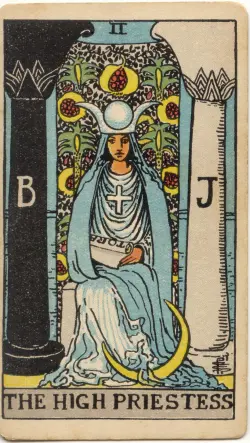
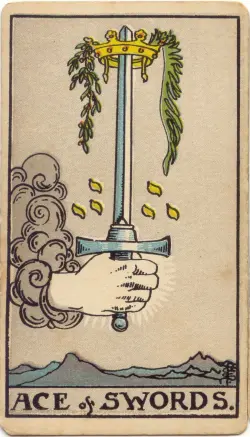
- Opposite: Two of Swords: The Two of Swords reflects evading truth and refusing to admit one's own role; Justice brings facts and personal accountability into plain view.
What do the imagery and Waite’s original text of Justice mean?
In the 1909 Rider-Waite-Smith deck, a figure sits between two stone pillars holding scales in one hand and an upright double-edged sword in the other, framed by a purple backdrop. In The Pictorial Key to the Tarot (1910), A.
E. Waite explained this moral principle as measuring according to human actions, distinguishing it from the mystical depths of The High Priestess. Divinatory meanings list fairness, right, and probity, with bigotry and severity in reverse.
- The scales: Represents equal and impartial weighing, viewing all evidence together before judging.
- Upright sword: Represents rational and decisive judgment, as well as the consequences that follow actions.
- Two pillars: Connects to balance, law, and structure, upholding order in the world.
- Purple veil: A reminder that fair judgment can still maintain compassion and human decency.
Related cards

Something on your mind? Let the cards help you look at it.
Ask a question with three cardsSources
- A. E. Waite | The Pictorial Key to the Tarot, Part II §2: Justice: Original description of the card illustration.
- A. E. Waite | The Pictorial Key to the Tarot, Part III §3: Justice: Original divinatory meanings for upright and reversed positions.
- Justice | Biddy Tarot: Referenced fair judgment, consequences of choices, and reversed bias and excessive self-reproach.
- Justice | Labyrinthos: Referenced honest accountability, fairness in relationships, and career and financial imbalances.
- Justice | Learning the Tarot: Referenced facing facts, accepting personal responsibility, and comparisons with Judgement and Two of Swords.
- Justice | Aeclectic Tarot: Referenced weighing based on facts, adjusting imbalances, and the symbolism of scales and sword.
Meaning updated: 2026-11-04 Card meanings are edited with AI assistance.
Tarot meanings are for self-reflection and reference only. They cannot predict the future, prove what someone else thinks, or guarantee an outcome. For decisions about health, law, money, pregnancy or personal safety, please talk to a qualified professional.