See situations clearly with a steady mind, make judgments grounded in fairness and principles, and voice conclusions with accountability.
King of Swords at a glance
- Upright keywords
- Clear judgment · Fair and impartial · High standards
- Reversed keywords
- Manipulative intellect · Harsh critiques · Scattered thinking
- Time to act?
- Upright: a good time to act; reversed: it depends on conditions
- Upright advice
- Write three lines of evidence for both sides of a dispute, then circle the conclusion you are willing to stand by publicly.
What does the King of Swords mean upright?
The King of Swords upright represents seeing situations with a clear, sober mind, pursuing truth, and deciding based on sound reasoning. You listen to different arguments without favoring either side, ensuring your conclusions align with your principles.
The King rank carries the responsibility of outwardly governing what has been understood. Amid chaos, you break problems down, identify actionable next steps, and express your views in words others can easily follow.
You hold yourself and others to high standards, maintaining integrity and taking rules seriously. Once things are clear, you state your position with a steady tone, letting listeners know exactly where you stand. When someone jumbles two proposals together, you ask for the evidence behind each before pointing out which one is actually viable.
What does the King of Swords mean reversed?
One direction of the King of Swords reversed is intellect and authority being used to dominate others or advance selfish interests. In this dynamic, you might experience this treatment from someone else, or catch yourself slipping into it in another setting.
Clever remarks are used to diminish people, while inconvenient facts are quietly removed to leave only a flattering narrative. If a barrage of jargon leaves your face burning, repeat their words silently to check whether any real reason was provided.
Inner confusion is another face of the reversal: thoughts scatter, and though you want to decide, you cannot settle on a direction. The signs are distinct: an intimidating person drops curt phrases and targets terms you cannot answer; a scattered mind changes plans three times and falls silent when questioned.
If you find yourself in the latter camp, read your top two options aloud and commit to just one tonight.
What does the King of Swords mean in love?
Single or getting to know someone
Upright: When choosing a partner, you value clear communication and personal integrity over fleeting romantic excitement. When invited out for the weekend, you pause before saying yes: "I want to be clear about my expectations first." It may sound direct, but it ensures they know what matters to you.
Reversed: An articulate talker can tempt you to ignore discomfort and lower your standards. When their sharp logic knocks away your questions, speaking up feels even harder. Watch whether they answer your specific question or use complex words to silence you.
In a relationship
Upright: You prioritize mutual respect and principles in your relationship, leaning more toward reasonable discussion than sweet talk. On an evening when your partner is distressed, you sit beside them and soften your pace: "I want to talk this through clearly, then be here for you." You might raise standards together, like ending the habit of interrupting.
Reversed: You reach out to connect, but your partner turns away, refusing to hear about your day. Withholding intimacy and support can be used as a punishment, with unpredictable moods. If this dynamic repeats, talk to a trusted family member or counselor to examine it together.
After a breakup or hoping to reconcile
Upright: The reasons for parting must be seen clearly; missing someone does not answer that core issue. In old messages, highlight only the single fundamental disagreement that never aligned. If you hope to reconcile, ask yourself right now: can I truly live with that issue?
Reversed: When a long draft message is written purely to prove the other person wrong, the intellect has become a weapon. Look back at the last argument: did they listen to the end, or dismiss you with a single verdict? Read that over before deciding whether to hit send tonight.
When drawing the King of Swords, what are the other person's thoughts and feelings toward me?
Cards cannot confirm another person’s true feelings; this section helps you explore possibilities rather than answer on their behalf.
Upright: They may respect your clarity and directness, feeling guided by honesty and reason, and are inclined to share their judgments openly with you. Watch whether they listen to differing views before concluding.
Reversed: They may feel confused and struggle to speak; if harsh remarks appear, see whether any supporting evidence follows.
What does the King of Swords mean for work and money?
Job hunting and interviews
Upright: Comparing two job postings side by side on your screen, you cross out buzzwords like "growth potential." What remains are the bullet points specifying weekly tasks, evaluated under the same standard. Choosing work this way ensures shiny titles never overshadow daily realities.
Reversed: On a call, a recruiter describes a role in glowing terms, but pivots to grandiose visions when you ask who signs off on work or defines success. When direction is vague, impressive titles are especially tempting. Do you want clear, documented weekly responsibilities, or a prestigious label?
In your current job
Upright: A supervisor may push you firmly toward your own high standards. Seeing a circled section on your submitted file with "Where is the evidence?" written beside it makes your ears warm. Incorporate that check into your routine before submitting work in the future.
Reversed: Decisions at work may lose structure and fairness when authority is used to shut down inquiry. A manager ends your question with jargon in front of the team, leaving your throat tight. Follow up after the meeting: "Could you share the basis for that decision with me?"
Money
Upright: Managing money relies on discipline and logic, checking all terms before major expenditures. Eyeing an expensive course, write the syllabus and refund policy in two lines, comparing them directly against an alternative. Only click pay when you can explain why you chose this one.
Reversed: An unexplained deficit appears in your account, and your finger hovers over the button to transfer funds to cover it. Wasteful spending or fruitless investments often come from slipped discipline. Write the purpose next to the notification; if you cannot, do not make the transfer tonight.
What does the King of Swords mean for friends, family and coworkers?
Upright: You hear both sides before making a judgment, holding yourself to the same standard. When two housemates argue over chores, you refuse to take sides prematurely. Say, "I want to hear both accounts in full first," giving the floor back to whoever was cut off.
Reversed: When clever words are used to dominate, you stare at the floor and swallow what you meant to say. A relative says, "You're being naive," and you squeeze your sleeve as explanations fade away. Notice whether a reason follows that remark; if not, do not absorb it.
What does the King of Swords mean for personal growth?
Upright: Before bed, divide the comment that bothered you today into two columns: what happened and how you interpreted it. The gap between them is usually where you added an assumption; circle it and ask which line holds up to scrutiny.
Reversed: You start second-guessing your judgment, revising conclusions three times and stirring up inner chaos. Another possibility is not needing public praise because you quietly know which principle holds firm. When self-doubt peaks, refrain from sending that third revision; when resting on principles, simply speak that rule softly to yourself.
What can you do when the King of Swords is your advice card?
Upright: Write three lines of evidence for both sides of a dispute, then circle the conclusion you are willing to stand by publicly. State that conclusion in a steady, complete sentence that can withstand scrutiny. If it involves legal or tax matters, bring the evidence to a specialist, but keep the decision yours.
Reversed: Paraphrase the other person's stance in your own words, then ask if you understood correctly. If you realize you only want to win the moment, simplify your conclusion to: "Here are my three reasons, and you are welcome to critique them."
Hearing another viewpoint is far closer to what is needed than forcing your single verdict.
Does the King of Swords say yes to what you asked?
Upright: It is a favorable time to lay out the evidence, clarify your standards, and proceed with what you asked about. When two options look appealing, identify the backing for each and choose the one you can stand behind publicly.
Reversed: It depends on whether you are being led by someone else's rhetoric or have yet to choose a direction. If the former, decline to agree; if the latter, narrow it down to two options and pick after writing out reasons.
Common questions about the King of Swords
What kind of person does the King of Swords represent?
This card represents someone who explains complex matters clearly, judges impartially, and holds themselves to principles. When consulting or setting rules, their expertise is valued while maintaining personal distance.
Reversed, they can be arrogant and sharp-tongued, using intellect to dominate and framing logic solely to their own advantage.
If the King of Swords reversed appears in a future position, what should I watch for?
A reversed card in a future position asks whether upcoming decisions can still be explained with sound reasons. Someone using authority or clever rhetoric to shut down debate is one pitfall; having your direction scatter across too many options is another.
Pause in either case and explain your reasoning to a single person before moving forward.
When drawing the King of Swords, how do I make academic judgments that hold up?
Trace the supporting evidence behind a conclusion before deciding whether you agree with it. When two theories sit side by side, review the data and adopt the one you can defend with clear reasons; omitting inconvenient data to win an argument or taking on too many topics at once easily shatters judgment.
A note from stilltarot
After hearing both sides, you still have no conclusion on your lips, and your chest feels tight. You have also spoken accurate words that left the room completely silent. Write the standard you truly believe in on paper today, and place it where you will see it first thing tomorrow.
How it differs from similar and opposite cards
- Similar: King of Cups: Both cards hold the King rank, contrasting through the water and air elements. The King of Cups puts family and relationships first; the King of Swords puts principles and truth before family loyalty.
- Opposite: King of Pentacles: The King of Swords and King of Pentacles share the King rank while contrasting opposing air and earth elements. The former outwardly governs ideas and judgment, while the latter anchors and manages work and daily life.
What do the imagery and Waite’s original text of the King of Swords mean?
This is the 1909 Rider-Waite-Smith card. The King sits in judgment holding an unsheathed sword upright, dressed in a blue tunic and purple mantle, with butterflies carved on the throne, cherubs and crescent moons beside his ears, and calm trees and clouds behind.
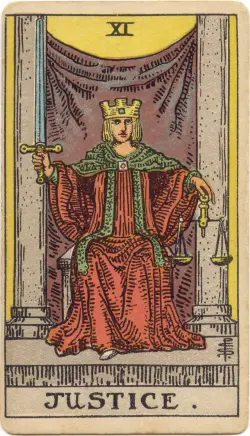
In his 1910 work The Pictorial Key to the Tarot, A. E. Waite notes that the figure recalls the Major Arcana's Justice, representing that virtue while emphasizing judicial authority. Upright meanings connect to judgment, command, and authority, while reversed meanings list cruelty, perfidy, and malice.
- Upright sword: The unsheathed, upright blade represents sober reason, decisive judgment, and openness to insight.
- Double-edged sword: The two edges signify mental clarity, intellectual strength, and accountability when speaking the truth.
- Blue tunic: The blue robe reflects spiritual understanding and a desire to know higher truths.
- Purple mantle: The purple cloak draped over the shoulders symbolizes compassion coexisting with intellect.
- Butterflies on throne: Butterflies carved on the back of the throne represent transformation.
- Cherubs near the ear: Cherubs and crescent moons carved beside the head suggest subtle guidance and discernment.
Related cards
Something on your mind? Let the cards help you look at it.
Ask a question with three cardsSources
- A. E. Waite | The Pictorial Key to the Tarot, Part III §2: King of Swords: Original description of the card illustration and upright and reversed divinatory meanings.
- King of Swords | Biddy Tarot: Clear reason, impartiality, principles, and reversed misuse of intellect to control or belittle others.
- King of Swords | Labyrinthos: High standards and restraint in love, reversed withholding of affection, and discipline in work and money.
- King of Swords | Learning the Tarot: Speaking clearly, judging without bias, and finding workable solutions amid chaos.
- King of Swords | Aeclectic Tarot: Considering varied accounts, reversed omission of inconvenient facts, and prioritizing truth over family loyalty compared to King of Cups.
Meaning updated: 2026-11-04 Card meanings are edited with AI assistance.
Tarot meanings are for self-reflection and reference only. They cannot predict the future, prove what someone else thinks, or guarantee an outcome. For decisions about health, law, money, pregnancy or personal safety, please talk to a qualified professional.